PERSON · APOSTLE
John the Apostle
John was called by Jesus from his fishing boat on the Sea of Galilee and was among the innermost circle of three disciples—with Peter and James—present at the Transfiguration (Matthew 17:1–2) and in Gethsemane (Mark 14:33). He was an eyewitness to the empty tomb (John 20:2–8) and a leading figure in the earliest Jerusalem church (Acts 3:1–11; Galatians 2:9).
Matthew 4:21–22
- Ministry
- First century AD; ministry active from c. AD 30 through the late first century
The Story
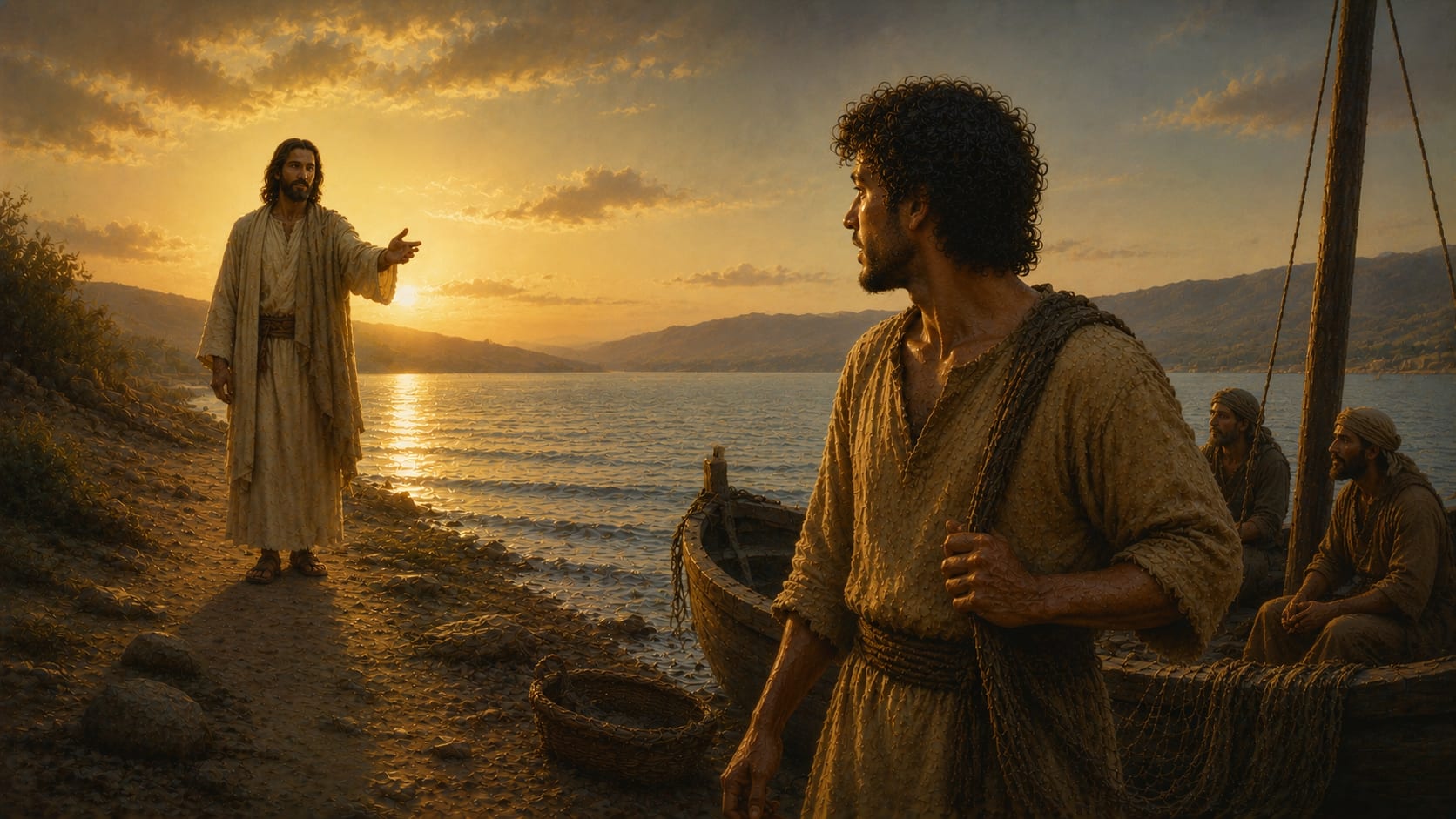
He was mending nets when the call came. The Sea of Galilee was a working world — ropes, hulls, the rhythm of labour shared with a father and a brother — and into that world stepped Jesus of Nazareth. Matthew's account is brisk about the moment: Jesus saw two brothers, James and John, in a ship with their father Zebedee, and he called them. They left the ship and their father and followed him.
21And going on from thence, he saw other two brethren, James the son of Zebedee, and John his brother, in a ship with Zebedee their father, mending their nets; and he called them. 22And they immediately left the ship and their father, and followed him.
Matthew 4:21–22·KJV
Whatever that departure cost Zebedee, Scripture leaves to the imagination. What it records is the speed of the response: the nets, the boat, the father — left behind.
From the beginning, John was not merely one of the Twelve but one of three. Time and again the Gospels narrow the circle — the room where Jairus's daughter lay, the slope of the Mount of Transfiguration, the shadows of Gethsemane — and at the centre of each scene stand Peter, James, and John. At the Transfiguration, John saw Moses and Elijah appear alongside a Jesus whose face shone like the sun and whose garments became white as light.
1And after six days Jesus taketh Peter, James, and John his brother, and bringeth them up into an high mountain apart, 2And was transfigured before them: and his face did shine as the sun, and his raiment was white as the light.
Matthew 17:1–2·KJV
He was there for that. He carried it.
Jesus gave the brothers a surname: Boanerges — Sons of Thunder.
17And James the son of Zebedee, and John the brother of James; and he surnamed them Boanerges, which is, The sons of thunder:
Mark 3:17·KJV
The name has a ring of wildness about it, and the Gospels offer a glimpse of what might have earned it. When a Samaritan village refused to receive Jesus, it was James and John who asked whether they should call down fire from heaven upon it. Luke records the question without embarrassment.
54And when his disciples James and John saw this, they said, Lord, wilt thou that we command fire to come down from heaven, and consume them, even as Elias did?
Luke 9:54·KJV
These were not quiet men, not in their early following. Thunder was the right word for the energy they brought.
Life & Legacy
Death
TraditionScripture does not record the death of John the Apostle. Church tradition holds that he died of old age in Ephesus, the only apostle not to suffer martyrdom, though he was exiled to the island of Patmos during the reign of Domitian (Revelation 1:9).
Eusebius, Ecclesiastical History 3.1; Revelation 1:9
Legacy
TraditionJohn is traditionally credited as the author of the Gospel of John, three epistles (1 John, 2 John, 3 John), and the Book of Revelation. Paul identified him, along with Peter and James, as one of the 'pillars' of the Jerusalem church (Galatians 2:9).
Galatians 2:9; Eusebius, Ecclesiastical History 3.24
Character
ScriptureJesus surnamed John and his brother James 'Boanerges,' meaning 'Sons of Thunder' (Mark 3:17). John is identified in the Gospel of John as 'the disciple whom Jesus loved,' reclining at Jesus's side at the Last Supper (John 13:23) and entrusted by Jesus with the care of his mother at the crucifixion (John 19:26–27).
Mark 3:17; John 13:23; John 19:26–27
Significance
ScriptureJohn was called by Jesus from his fishing boat on the Sea of Galilee and was among the innermost circle of three disciples—with Peter and James—present at the Transfiguration (Matthew 17:1–2) and in Gethsemane (Mark 14:33). He was an eyewitness to the empty tomb (John 20:2–8) and a leading figure in the earliest Jerusalem church (Acts 3:1–11; Galatians 2:9).
Matthew 4:21–22; Matthew 17:1–2; John 20:2–8; Acts 3:1–11
DeathTradition
Scripture does not record the death of John the Apostle. Church tradition holds that he died of old age in Ephesus, the only apostle not to suffer martyrdom, though he was exiled to the island of Patmos during the reign of Domitian (Revelation 1:9).
Eusebius, Ecclesiastical History 3.1; Revelation 1:9
LegacyTradition
John is traditionally credited as the author of the Gospel of John, three epistles (1 John, 2 John, 3 John), and the Book of Revelation. Paul identified him, along with Peter and James, as one of the 'pillars' of the Jerusalem church (Galatians 2:9).
Galatians 2:9; Eusebius, Ecclesiastical History 3.24
CharacterScripture
Jesus surnamed John and his brother James 'Boanerges,' meaning 'Sons of Thunder' (Mark 3:17). John is identified in the Gospel of John as 'the disciple whom Jesus loved,' reclining at Jesus's side at the Last Supper (John 13:23) and entrusted by Jesus with the care of his mother at the crucifixion (John 19:26–27).
Mark 3:17; John 13:23; John 19:26–27
SignificanceScripture
John was called by Jesus from his fishing boat on the Sea of Galilee and was among the innermost circle of three disciples—with Peter and James—present at the Transfiguration (Matthew 17:1–2) and in Gethsemane (Mark 14:33). He was an eyewitness to the empty tomb (John 20:2–8) and a leading figure in the earliest Jerusalem church (Acts 3:1–11; Galatians 2:9).
Matthew 4:21–22; Matthew 17:1–2; John 20:2–8; Acts 3:1–11
Artist's impression