
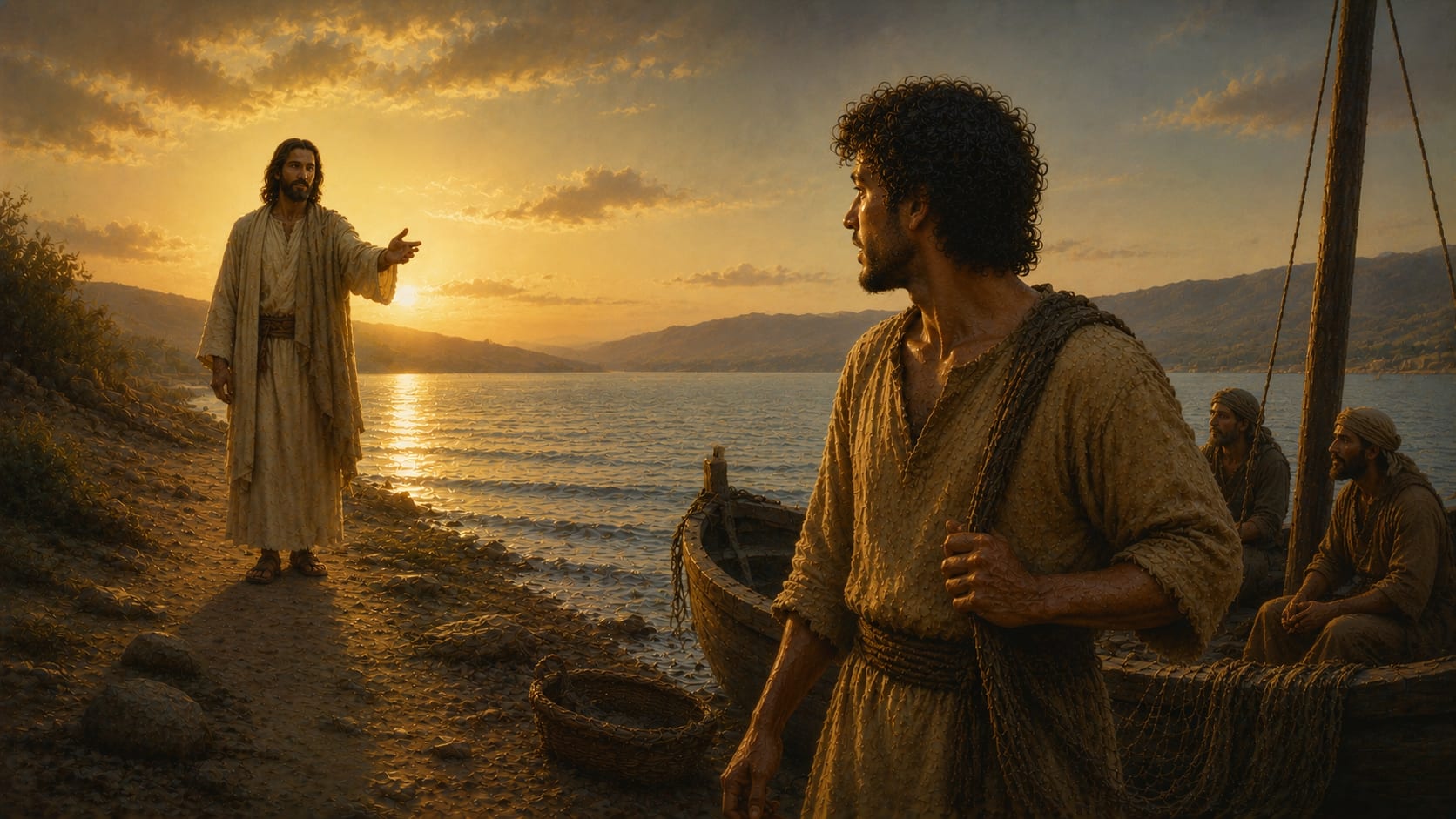
Artist's impression
Era
Early Church
Country
Roman Empire (Asia Minor, modern Turkey)
Century
2nd
Theme
Faithfulness
He was an old man on a farm outside the city when the soldiers came for him.
The city was Smyrna, on the west coast of what the Romans called the province of Asia — the country we now call Turkey, on a wide bay where the Aegean turns inland. Smyrna in the second century was a proud Roman town of temples and games, and it had a small church that had been there almost as long as anyone could remember. The bishop of that church was named Polycarp. He had been a Christian all his life. He said so himself, at the end.
He had been born around the year 69, and the old men in the church remembered that when he was young he had sat under the teaching of the Apostle John. Irenaeus, who as a boy heard Polycarp preach, would later insist on this — that the bishop of Smyrna had spoken with those who had seen the Lord, and had passed on what they said, plainly, without embellishment. It was one of the reasons the churches of Asia loved him. He was the last living thread back to the men who had walked with Jesus.
He lived quietly. He wrote letters, most of them lost now; only one survives, a short pastoral letter to the Philippians warning them against greed and false teachers and urging them to imitate the patience of Christ. He travelled once to Rome, an old man already, to talk with the Roman bishop about the date of Easter. They could not agree, and they parted as friends anyway. It is the kind of detail that tells you what sort of man he was.
Then in February of 155 the persecution came to Smyrna.

It was not, at first, about Polycarp. Twelve believers from Smyrna and Philadelphia were arrested and sent into the arena. A young man named Germanicus faced the wild beasts with such steadiness that the crowd, watching, grew angry — not at him, but at the whole race of Christians. Away with the atheists, they shouted. It was what Romans called people who would not worship the gods of the city. Find Polycarp.
His friends persuaded him to leave the city. He went to a small farm outside the walls, and he prayed. The account that survives, written within weeks of his death by the church at Smyrna itself, says he had a vision there: his pillow was on fire beneath his head. He woke and told those with him what it meant. He would be burned alive.
The soldiers came in the evening. They found him upstairs. He could have hidden further — there was time — but he came down and said, the will of God be done. Then he asked whether he might have an hour to pray, and they let him, and he stood and prayed aloud for two hours, remembering by name every person he had ever known in the church, and every church he had ever heard of, and the soldiers listened, and some of them, the account says, began to be sorry that they had come.
They put him on a donkey and brought him back into the city.
On the way the chief of police, a man named Herod, took him into his own carriage and tried, almost kindly, to talk sense into him. What harm is there, he said, in saying Caesar is Lord, and offering a little incense, and being saved? Polycarp would not answer. Herod grew angry and pushed him out of the carriage, and the old man hurt his shin on the ground, and got up, and walked the rest of the way as if nothing had happened.
The arena was full. It was a Sabbath, and the games were on, and the crowd had come for blood, and now the great prize of the day had been brought in — an old bishop, white-haired, limping, unafraid.
As he stepped onto the sand, those standing near him said afterwards that they heard a voice. It came from above the noise, from nowhere they could see, and it said,
“Be strong, Polycarp, and play the man.”
No one else heard it. The old man did.
The proconsul that year was called Statius Quadratus. He had a script he was meant to follow with Christians, and he tried it. Have respect for your age. Swear by the genius of Caesar. Repent. Say, Away with the atheists.
Polycarp turned his head and looked at the crowd — the whole roaring mass of them, packed on the stone benches, calling for his death. He lifted his hand. He groaned, and he looked up, and he said it.
“Away with the atheists.”
The proconsul, missing the joke entirely, pressed him again. Swear the oath. I will release you. Just curse Christ.
The old man answered.
“Eighty and six years have I served him, and he has done me no wrong; how then can I blaspheme my King who saved me?”

The proconsul threatened him with wild beasts. Polycarp said, bring them. He threatened him with fire. Polycarp said the fire he was threatened with burned only for an hour, and there was another fire he feared more. Then he stopped speaking, and the herald went out into the middle of the arena and cried three times, Polycarp has confessed himself a Christian, and the crowd howled for him to be burned.
They gathered the wood quickly. The Jews of the city, the letter records without malice, ran to the workshops and the baths for logs. When they were ready to nail him to the stake he asked them not to — leave me as I am, he said, the one who gives me strength to bear the fire will give me strength to stand still in it — and so they only tied him. He prayed once more, thanking God that he had been counted worthy of this hour, and the torch was put to the wood.
The eyewitnesses said the flame arched over him like a sail. It did not consume him. They said he stood inside it as bread bakes inside an oven, or gold in a furnace. In the end an executioner was ordered to finish him with a dagger. He was eighty-six years old.
His friends gathered what was left of him — bones, the letter says, more precious than jewels — and they buried him, and they kept the day. They called it his birthday. Every year on the 23rd of February the church at Smyrna gathered at his tomb, not to mourn him but to remember that a man had stood in the arena of that city and had refused, gently and without heat, to speak evil of the King who had saved him.
The letter they wrote to tell the story is the oldest account of a Christian martyrdom outside the New Testament. It has been copied and copied for eighteen hundred years. Almost everything Polycarp wrote is gone. This is what remains: the answer of an old man, on a Sabbath afternoon, in a stadium in Smyrna, when the whole city was waiting for him to save his life with one small sentence, and he would not.
Eighty and six years.
He had served that long, and he was not about to stop now.
Scripture Behind This Story
8And unto the angel of the church in Smyrna write; These things saith the first and the last, which was dead, and is alive; 9I know thy works, and tribulation, and poverty, (but thou art rich) and I know the blasphemy of them which say they are Jews, and are not, but are the synagogue of Satan. 10Fear none of those things which thou shalt suffer: behold, the devil shall cast some of you into prison, that ye may be tried; and ye shall have tribulation ten days: be thou faithful unto death, and I will give thee a crown of life. 11He that hath an ear, let him hear what the Spirit saith unto the churches; He that overcometh shall not be hurt of the second death.
Revelation 2:8–11·KJV
Reflection
Most of us will never stand in an arena. What Polycarp shows is smaller, and closer. Eighty-six years of serving one King, and at the end of them the arithmetic still held: he has done me no wrong. A life is a long addition. Every quiet obedience is a number on the page. When the pressure finally comes, what answers is whatever has been added up. Polycarp's answer was not manufactured in the arena. It was simply read aloud from a page he had been writing since he was a boy.
Prayer
Father, we thank You for the old bishop of Smyrna, and for the King he would not curse. Give us a long, quiet faithfulness — the kind that adds up, day by unremarkable day — so that when our hour comes, whatever it looks like, we may answer as he did: You have done us no wrong. In the name of Jesus, our King and Savior. Amen.
Explore the Knowledge Web
Themes, people and places woven through this story.
Quick Facts7
- Born
- c. AD 69
- Died
- 23 February, c. AD 155 (aged 86)
- Role
- Bishop of Smyrna; Apostolic Father
- Discipled by
- John the Apostle (per Irenaeus)
- Surviving writing
- Epistle to the Philippians
- Feast day
- 23 February
- Modern location
- İzmir, Turkey
Timeline9
c. 69
Polycarp born, likely in Asia Minor
c. 80s–100
Learns the faith from the Apostle John and other eyewitnesses of the Lord
c. 110
Receives a letter from Ignatius of Antioch, who is on his way to martyrdom in Rome
c. 110–120
Writes his Epistle to the Philippians
c. 154
Travels to Rome to confer with Bishop Anicetus over the date of Easter
23 Feb, c. 155
Arrested, tried before proconsul Statius Quadratus, and martyred in the arena at Smyrna
c. 155–160
The church at Smyrna writes the letter now known as the Martyrdom of Polycarp
c. 180
Irenaeus, once a hearer of Polycarp, writes of him in Against Heresies
c. 325
Eusebius preserves much of the Martyrdom in Ecclesiastical History IV.15
Sources6
- The Martyrdom of Polycarp (Letter of the Smyrnaeans to the Philomelians), c. AD 155–160; trans. J.B. Lightfoot and Kirsopp Lake
- Polycarp, Epistle to the Philippians, c. AD 110–120
- Irenaeus of Lyons, Against Heresies III.3.4; Letter to Florinus (fragments)
- Eusebius of Caesarea, Ecclesiastical History IV.14–15, c. AD 325contested
- Encyclopædia Britannica, 'Saint Polycarp'
- Waddington, Mémoire sur la chronologie de la vie du rhéteur Aelius Aristide (1867) — proconsulship of Statius Quadratus dated to 153–56, fixing Polycarp's death at 23 Feb 155contested
Part of the FaithMax library of Christian history — faithful lives across twenty centuries. Explore →