
Era
Missionary Era
Country
Scotland
Century
19th
Theme
Faithfulness in the long obedience
He was ten years old when he started work at the cotton mill in Blantyre, a village on the River Clyde in the south of Scotland. The whistle blew at six in the morning. The whistle blew again at eight at night. In between, David Livingstone learned to read Latin with a book propped on the spinning jenny, the roar of the machinery so thick around him that he taught himself to hear through it.
That is where the story of the Scottish missionary to Africa begins. Not on the Zambezi. Not at Victoria Falls. In a single tenement room shared with six brothers and sisters, a boy who worked fourteen hours a day and then walked to evening school and read past midnight because there was a hunger in him that the mill could not use up.
He wanted, at first, to go to China. He studied medicine in Glasgow so that, like Christ, he could preach and heal. He was accepted by the London Missionary Society. And then the Opium War closed China, and the door he had been walking toward for years was suddenly a wall.
It was in that season of waiting that he heard Robert Moffat speak.
Moffat was a veteran missionary, home in Britain from twenty years in South Africa. He was looking for a young man to send north into country no missionary had entered. Livingstone stayed behind after a meeting and asked, very directly, whether he would do for Africa. Moffat wrote the answer down in his diary: he would do, if he would not settle at an old station but push north, to the vast plain where Moffat had sometimes seen, in the morning sun, the smoke of a thousand villages where no missionary had ever been.
“I said I believed he would, if he would not go to an old station, but would advance to unoccupied ground, specifying the vast plain to the north, where I had sometimes seen, in the morning sun, the smoke of a thousand villages, where no missionary had ever been.”
A sentence like that can decide a life.
Livingstone sailed for the Cape in December 1840. He was twenty-seven. He would not see Britain again for sixteen years, and when he did the country would greet him as a hero he did not quite know how to be.
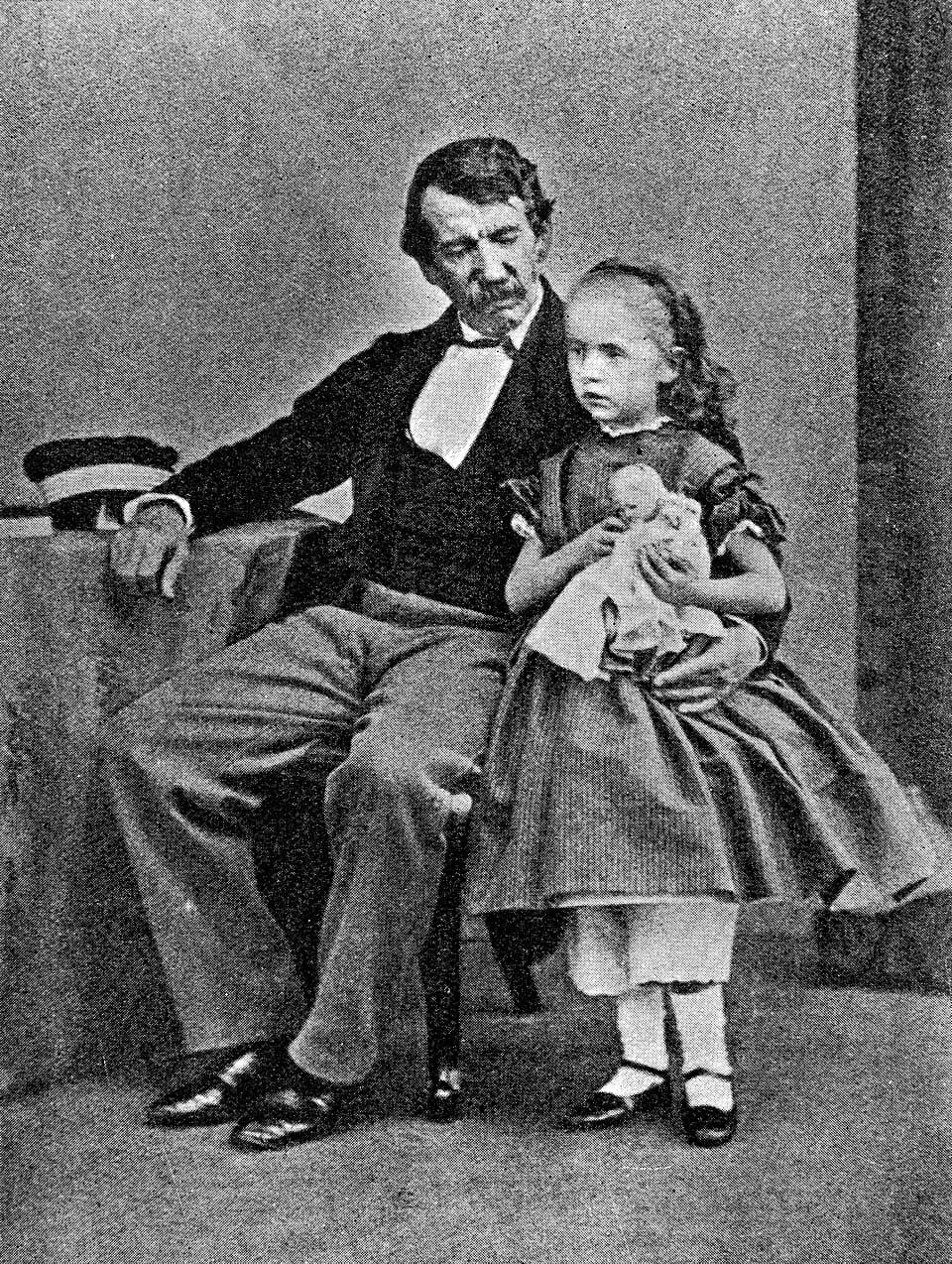
The first years in Africa were the making of him. He walked. He learned Setswana until he could preach in it. He set up a station at Mabotsa, in what is now South Africa, among a people called the Bakhatla. The village was plagued by lions, and one February afternoon in 1844 he went out with a gun and a native deacon named Mebalwe to shoot one.
He fired both barrels into the animal and turned to reload.
The lion took him by the shoulder and threw him to the ground. Livingstone wrote about it later in the flattest voice he could manage, because he hated the way the story got told. He said the beast shook him as a terrier dog does a rat, and that the shock produced a kind of dreaminess, no pain, no fear. Mebalwe fired and his rifle misfired; the lion sprang on him instead; another man was bitten; and then, from the wounds Livingstone had put into it, the animal simply dropped dead.
“Growling horribly close, he shook me as a terrier dog does a rat. The shock produced a stupor similar to that which seems to be felt by a mouse after the first grip of the cat. It caused a sort of dreaminess, in which there is no sense of pain nor feeling of terror.”
He set the splintered bone of his own arm. It never healed straight. For the rest of his life his left arm could not lift a gun properly, and thirty years later, when they needed to identify his body in London, it was the badly-set humerus that told them who he was.
The following year he married Mary Moffat, Robert's daughter, who had grown up in Africa and knew what she was walking into.
Then he began to walk in earnest.
He went north, and further north, out beyond any station, out of range of any mission committee. In November 1855 he stood on the Zambezi and became the first European to see the great falls the Kololo people called Mosi-oa-Tunya, the smoke that thunders. He named them after his queen. He was doing something no one had asked him to do, and something the Missionary Society could not quite categorise: he was mapping a continent to open it — to Christian mission, to lawful trade, to anything that might break the trade that had begun to fill him with a settled, unshakeable horror.
He had walked into the country of the East African slave trade. He had seen women shot on the path because they could not walk any further. He had seen children left in slave-sticks to starve because their master had run out of food. And whatever else the interior of Africa was to him — geography, botany, the sources of the Nile — it was above all this: an open sore.
That was his phrase, and he used it until it became his epitaph.
“All I can add in my solitude, is, may Heaven's rich blessing come down on every one, American, English, or Turk, who will help to heal this open sore of the world.”
Missionary Travels was published in 1857 and sold in numbers no missionary book had sold before. Britain discovered him. The universities gave him honours. Crowds packed halls to hear him speak. He was, for a season, the most famous Scot alive. And then he went back to Africa, because the mapping was not finished and the sore was not healed.
The final journey began in 1866 and did not end. He was looking, now, for the source of the Nile — partly because geography drew him and partly because he believed a great discovery would give him a platform from which to shame the slavers of the world into stopping. He got bogged in the swamps around Lake Bangweulu. He lost his medicines to a deserter. He lost his teeth. He lost, for months at a time, all contact with the world beyond the reeds.
Britain thought he was dead.
The New York Herald sent a Welsh-born reporter called Henry Morton Stanley to find him. Stanley walked for eight months. In November 1871, in the trading town of Ujiji on Lake Tanganyika, in what is now Tanzania, Stanley came into the market and saw a thin white man among the crowd and, by his own account, lifted his hat and said the sentence the English-speaking world has been repeating ever since.
Livingstone, I presume.

Stanley stayed four months. He begged Livingstone to come home. Livingstone would not. He resupplied him and left, and Livingstone turned south again, into the swamps, into the malaria, into whatever was left of the map.
He kept his journal. On the first of May, 1872, exactly a year before he died, he wrote the words that would be carved onto his tomb: that in his solitude he could only ask heaven's blessing on every man, American, English, or Turk, who would help to heal the open sore of the world.
By April 1873 he could not walk. His African companions — Chuma, Susi, and a small band who had stayed with him through years no European would have endured — carried him on a litter into the village of Chief Chitambo, near Lake Bangweulu, in what is now Zambia. On the night of the last day of April they laid him on a bed of grass and branches inside a hut, and left him.
In the early hours of May 1st they came in with a candle to check on him.
He was kneeling by the bed. His head was on the pillow. He had not moved.
He had gone to his knees to pray and had not come back up.
The men did what they knew how to do. They cut open his chest and took out his heart, and they buried it under a mpundu tree in the soil he had spent thirty years walking. Jacob Wainwright, a freed slave of Yao origin who had come into the party as an interpreter, carved the name and the date into the bark. Then they dried the body in the sun, wrapped it in bark and sailcloth, and lashed it to a pole.
And they carried him to the sea.
It took them nine months. They crossed country where a dead man could not lawfully be moved, and where their own lives were forfeit if they were caught with one. They lied and hid and kept walking. They handed the body at last to the British consul at Zanzibar, and it was shipped to Southampton, and identified in London by the crooked left arm, and taken to Westminster Abbey.
On the 18th of April, 1874, in a great Victorian funeral, the son of the Blantyre cotton mill was buried among the kings of England. The slab reads: Brought by faithful hands over land and sea, here rests David Livingstone, missionary, traveller, philanthropist.
His heart, of course, was not in the box.
His heart was under the mpundu tree, in the country he had walked into as a young man because an older missionary had described smoke rising, at dawn, from villages that had never heard the name of Christ.
Six weeks after they buried him at the Abbey, Parliament outlawed the East African slave trade.
Scripture Behind This Story
8Also I heard the voice of the Lord, saying, Whom shall I send, and who will go for us? Then said I, Here am I; send me.
Isaiah 6:8·KJV
Reflection
A boy at a spinning jenny learned to read past the noise. A young man walked toward a closed door and then toward a sentence about smoke rising at dawn. An old man was carried on a litter into a village he had never planned to see, and knelt beside a bed of grass. Not everyone gets a map like his. But every life is walked one door at a time, and one refusal at a time, and one small obedience at a time — and there is usually smoke rising, somewhere, that we have already learned to see.
Prayer
Father, we thank you for men and women who have walked toward the smoke of villages we would never have found. Give us the same slow obedience — the willingness to keep going after the door we expected closes, and the honesty to name the evils of our day for what they are. And when we come at last to a bed of grass in a country not our own, let us be found on our knees. In Jesus' name, amen.
Quick Facts7
- Born
- 19 March 1813, Blantyre, Scotland
- Died
- 1 May 1873, Chitambo, present-day Zambia
- Tradition
- Congregationalist
- Sending body
- London Missionary Society
- Field
- Southern and Central Africa (1841–1873)
- Known for
- Opening Africa's interior to Christian mission; abolitionist campaign against the East African slave trade
- Buried
- Westminster Abbey, 18 April 1874 (heart buried at Chitambo)
Timeline13
1813
Born 19 March in Blantyre, Lanarkshire, Scotland.
1823
Begins work at Blantyre cotton mill, aged ten.
1840
Accepted by the London Missionary Society; sails for Cape Town in December.
1841
Arrives in South Africa; begins work near Kuruman.
1844
Mauled by a lion at Mabotsa on 16 February; left arm never fully recovers.
1845
Marries Mary Moffat.
1855
First European to see Victoria Falls (Mosi-oa-Tunya), 16 November.
1857
Publishes Missionary Travels and Researches in South Africa; becomes a household name in Britain.
1866
Begins his final expedition into central Africa in search of the Nile sources.
1871
Met at Ujiji by Henry Morton Stanley, c. 10 November.
1872
Writes on 1 May his 'open sore of the world' passage — one year to the day before his death.
1873
Dies at Chitambo's village, Ilala (now Zambia), 1 May; heart buried under a mpundu tree.
1874
Body arrives in Britain; buried at Westminster Abbey, 18 April. Weeks later, Parliament outlaws the East African slave trade.
Sources10
- Britannica, 'David Livingstone'
- Westminster Abbey, 'David Livingstone'
- Wikipedia, 'David Livingstone'
- David Livingstone, Missionary Travels and Researches in South Africa (London: John Murray, 1857)
- David Livingstone, The Last Journals of David Livingstone, in Central Africa, from 1865 to His Death (posth. 1874)
- Christian History Institute, 'David in the Lion's Den'
- Livingstone Online, 'Livingstone's Life & Expeditions'
- Smithsonian Libraries, 'David Livingstone and the Other Slave Trade' (2013)
- The Personal Life of David Livingstone (William G. Blaikie, 1880), Ch. IV
- Newsletter.co.uk, 'Dr Livingstone I presume? Iconic meeting was 150 years ago'contested
Part of the FaithMax library of Christian history — faithful lives across twenty centuries. Explore →