
William Tyndale
The scholar from Gloucestershire who gave England the Bible in its own tongue — and paid for it at Vilvoorde.
Artist's impression
Era
Reformation
Country
England
Century
16th
Theme
The word in the mother tongue
He was a boy from the Cotswolds who would die in a castle in Belgium, and the crime for which he died was giving his own countrymen the New Testament in their own tongue.
William Tyndale was born around 1494 in Gloucestershire, England — in Melksham Court, Stinchcombe, near Dursley, a village of stone and sheep. He was clever from the start. By twelve he was already at Oxford. By twenty-one he had his master's degree from Magdalen Hall. He learned Greek and Hebrew and Latin and French and German and Spanish and Italian, the way another kind of man collects fields. What he did with those languages was one small thing that reshaped a country.
He wanted the Bible in English.
That does not sound like a crime. In sixteenth-century England it was. An old ruling from 1409, the Constitutions of Oxford, still stood: no English translation of Scripture without a bishop's approval. There was no such approval to be had. The Bible was Latin, and Latin was the priests', and the priests told the people what the priests decided the people should hear. Tyndale had watched country parsons stumble over their own creed. He had listened to sermons that never opened the book they claimed to serve.
Around 1521 he became chaplain and tutor in the house of Sir John Walsh at Little Sodbury, a manor a few hours' ride from where he was born. Clergymen came to dinner. Tyndale argued with them across the table. One of these evenings a learned man told him it would be better to have the Pope's laws than God's. According to John Foxe, writing a generation later, Tyndale answered:
“I defy the Pope and all his laws; if God spare my life, ere many years, I will cause a boy that driveth the plough to know more of the Scriptures than thou dost.”
Whether he said it in those exact words or Foxe sharpened them, the sentence is the shape of his whole life afterward. A boy at a plough. Not a bishop. Not a scholar. A boy pushing a blade through English soil, knowing the Scriptures better than the men in vestments.
He went to London to ask Bishop Cuthbert Tunstall for permission and a roof under which to translate. Tunstall, uneasy like most of his brethren with the Bible in the vernacular, turned him away. So Tyndale did what men of that century did when England had no room for them. He crossed the sea.

He never came home.
In Germany he began the work. He translated from Erasmus's Greek New Testament — the printed Greek text of 1516 that had made this whole endeavour thinkable. In 1525 the printing began in Cologne at the press of Peter Quentell. A drunk boast in a tavern reached the ears of Johann Cochlaeus, an anti-Lutheran priest, who raced to the authorities. Tyndale and his assistant William Roye gathered what pages they had and fled up the Rhine by night to Worms, the city where Luther had stood before the Emperor four years earlier. In the shop of Peter Schöffer the Younger, in 1526, the first complete printed English New Testament was finished. Three thousand copies, or more.
They were smuggled into England in bales of cloth, in sacks of flour, in the false bottoms of merchants' crates.
Bishops bought them and burned them at Paul's Cross. The burnings paid for more printings. Tunstall's bonfire in London in October 1526 funded, without his knowing it, the next edition. Tyndale kept working. He learned Hebrew, which almost no Englishman then knew, and translated the Pentateuch, and Jonah, and much of the historical books. He wrote The Obedience of a Christian Man. He wrote The Practice of Prelates against Henry VIII's divorce, which turned the King's fury toward him personally.
By 1534 he was living quietly in the English House in Antwerp under the protection of the merchant Thomas Poyntz. That was where an Englishman named Henry Phillips found him.
Phillips was well-born and ruined. He had gambled away his inheritance and taken money — no one is certain from whom — to hunt Tyndale down. He came to Antwerp in the early summer of 1535 and made himself agreeable. He borrowed money from Tyndale. He ate at his table. Tyndale, who trusted him, showed him his books.
On the 21st of May, 1535, Phillips walked out of Poyntz's house with Tyndale beside him into a narrow alley where imperial officers were waiting. Tyndale was taken to the castle of Vilvoorde, six miles north of Brussels, and locked in a cell.
He stayed there for sixteen months.
One letter of his from that prison survives — in Latin, asking the governor for warmer clothing, a cap for his head, a candle, and above all his Hebrew Bible, grammar and dictionary, that he might go on studying. The sources do not record whether the books came. What we know is that he kept working while he could. Some scholars believe the Old Testament translation he finished in prison passed, by hidden hands, into the Bible that was printed in the year of his death.
Thomas Cromwell wrote from England on his behalf. It made no difference. In August 1536 Tyndale was condemned as a heretic, degraded from the priesthood, and handed over to the secular arm.
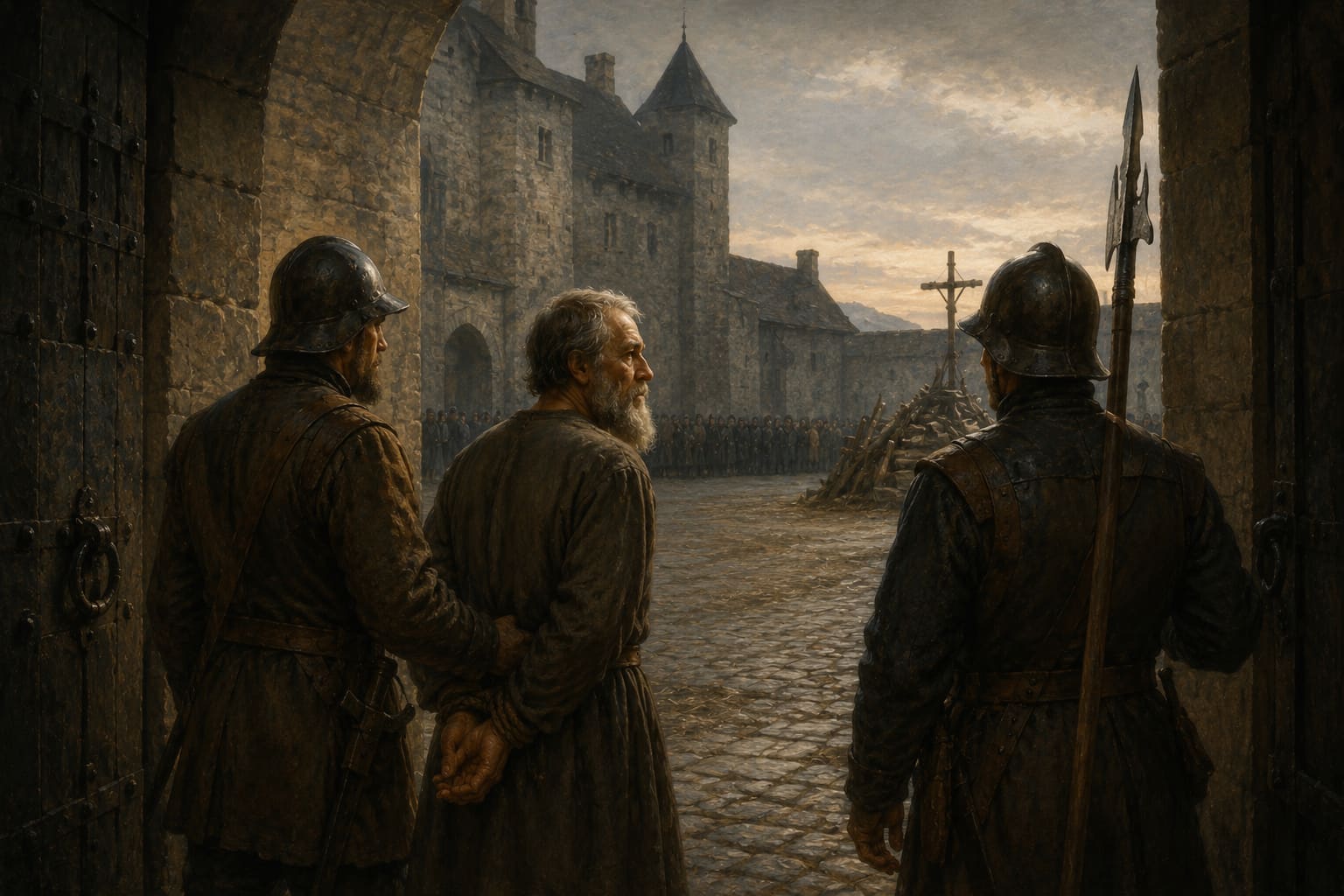
On the sixth of October, 1536, they led him from the cell into the courtyard of the castle. The pyre was built like a small wooden house around a cross. Gunpowder had been packed among the faggots. He was tied to the beam. He was allowed a moment to pray.
Foxe records what he said before the executioner tightened the cord.
“Lord, open the King of England's eyes.”
The hangman strangled him. Then the wood was lit and the gunpowder took, and there was nothing left of William Tyndale but ash on Flemish stone.
Three years later, in 1539, a Bible in English was placed by royal order in every parish church in England. It was called the Great Bible. Miles Coverdale had assembled it. The New Testament in it was Tyndale's, word for word in most places. The Pentateuch was Tyndale's. Jonah was Tyndale's. The books he had never lived to finish were finished by other hands, but the voice underneath was still his.
Seventy-two years after that, in 1611, the translators of the King James Bible sat down with the Hebrew, the Greek, the Latin, and the English versions before them. When they came to render a verse, again and again they chose what Tyndale had already written. Scholars have counted. Somewhere between eighty and ninety percent of the New Testament in the King James Version is Tyndale's English, unaltered or barely altered.
Every English-speaking Christian who has ever prayed the Lord's Prayer in the words "Our Father which art in heaven, hallowed be thy name" has prayed in Tyndale's English. Every reader who has met the phrase "the powers that be", or "the salt of the earth", or "a law unto themselves", or "fight the good fight", or "let there be light" in the Genesis of the King James, has read Tyndale.
He never saw a copy of his own completed Bible. He never went home. He was buried nowhere anyone can now find. His mother tongue absorbed him instead. Four hundred years later, when an English-speaking child in Kenya or Kentucky or Cornwall opens a Bible and reads it aloud, some of the sentences leaving that child's mouth are the sentences a man wrote at a desk in Antwerp, at a desk in Worms, in a cold cell at Vilvoorde, waiting to be killed.
The ploughboy knows more of the Scriptures now.
Scripture Behind This Story
1In the beginning was the Word, and the Word was with God, and the Word was God. 2The same was in the beginning with God. 3All things were made by him; and without him was not any thing made that was made. 4In him was life; and the life was the light of men. 5And the light shineth in darkness; and the darkness comprehended it not.
John 1:1–5·KJV
Reflection
A man died so that a language could hear the gospel plainly. Most of us own more Bibles than we open. The words on those shelves cost someone his life. It is worth asking, quietly, what we do with what was paid for — whether the sentences purchased by ash and rope sit unread on our nightstand, or whether we still recognise, when we open them, that they are somebody's last gift.
Prayer
Father, we thank You for the men and women who paid to give us Your word in our tongue. Make us slow to take for granted the Bible on our shelves, and quick to open it. Where our own eyes are shut, open them. Amen.
Quick Facts5
- Born
- c. 1494, Gloucestershire, England
- Died
- 6 October 1536, Vilvoorde, Belgium (strangled and burned)
- Known for
- First printed English translation of the New Testament from the Greek (1526)
- Languages
- Fluent in English, Latin, Greek, Hebrew, French, German, Italian, Spanish
- Legacy
- Estimated 80–90% of the King James New Testament is Tyndale's wording
Timeline13
c. 1494
Born in Gloucestershire, England
1512
B.A., Magdalen Hall, Oxford
1515
M.A., Oxford; ordained priest
c. 1521
Chaplain to Sir John Walsh at Little Sodbury
1524
Leaves England for the Continent
1525
NT printing begun at Cologne, disrupted by Cochlaeus
1526
First complete printed English NT finished at Worms
1530
Publishes translation of the Pentateuch
May 1535
Betrayed by Henry Phillips; arrested in Antwerp
1535–1536
Imprisoned at Vilvoorde Castle
6 Oct 1536
Strangled and burned at Vilvoorde
1539
The Great Bible (largely Tyndale's) placed in every English parish church
1611
King James Version published — 80–90% of its NT is Tyndale's
Sources9
- John Foxe, Acts and Monuments (Book of Martyrs), 1563 / 1570 editionscontested
- 'William Tyndale', Wikipedia
- 'William Tyndale', Encyclopaedia Britannica
- 'William Tyndale (1494–1536)', Hertford College, University of Oxford
- 'Tyndale's Betrayal and Death', Christian History Magazine (Christianity Today), 1987
- 'The newe Testament, Worms 1526: William Tyndale and his Printer Peter Schöffer the Younger Revisited', Reformation 20 (2015)
- Jan J. Martin, 'William Tyndale, John Foxe, and the Boy That Driveth the Plough', Religious Educator 17:2 (2016), 86–105contested
- 'William Tyndale', Banner of Truth
- 'William Tyndale: Life, Legacy, and Belgian Connections', Discovering Belgium
Part of the FaithMax library of Christian history — faithful lives across twenty centuries. Explore →