
John Huss
The Bohemian priest who preached in his people's language and would not unsay it, c. 1369 – 1415
Artist's impression
Era
Medieval
Country
Czech Republic (Bohemia)
Century
15th
Theme
Truth-telling under pressure
The village that made him was called Husinec, in the south of Bohemia — the country we now call the Czech Republic. The name meant Goose Town. He took his surname from the place, shortened it to Hus, and for the rest of his life made small jokes about being a goose. He would have no idea, at the end, how far that joke would fly.
He was born around 1369 into a family with no money and no name. His mother taught him to pray. She wanted him for the priesthood, and he confessed, later, that he had wanted it too, mostly because he was hungry. He walked to Prague as a boy and paid his way through school by singing in the churches and serving at their altars. In one of his own recollections he described making a spoon out of a piece of bread so he could scoop peas with it. That was the young man who would one day face a council of cardinals.
Prague took him in. He was quick, and he was patient, and he stayed. Bachelor of Arts in 1393. Master's degree in 1396. Ordained a priest in 1400. Rector of the university in 1402. In March of that same year he was made preacher at a chapel in the Old Town that had been built, only a decade earlier, for a purpose almost no one else in Prague was attempting. The Bethlehem Chapel was designed for sermons in Czech.
Latin was the language of the church. Latin was the language of the schoolmen and the cardinals and the pope. Czech was what the baker spoke to his wife. When Hus climbed the pulpit at Bethlehem and began preaching to farmers and weavers and the queen of Bohemia herself in the tongue of their own homes, three thousand people could crowd in to hear him. He preached against the selling of indulgences. He preached that Christ, not the pope, was the head of the church. He preached, patiently, week after week, from a Bible he was helping to render into Czech.
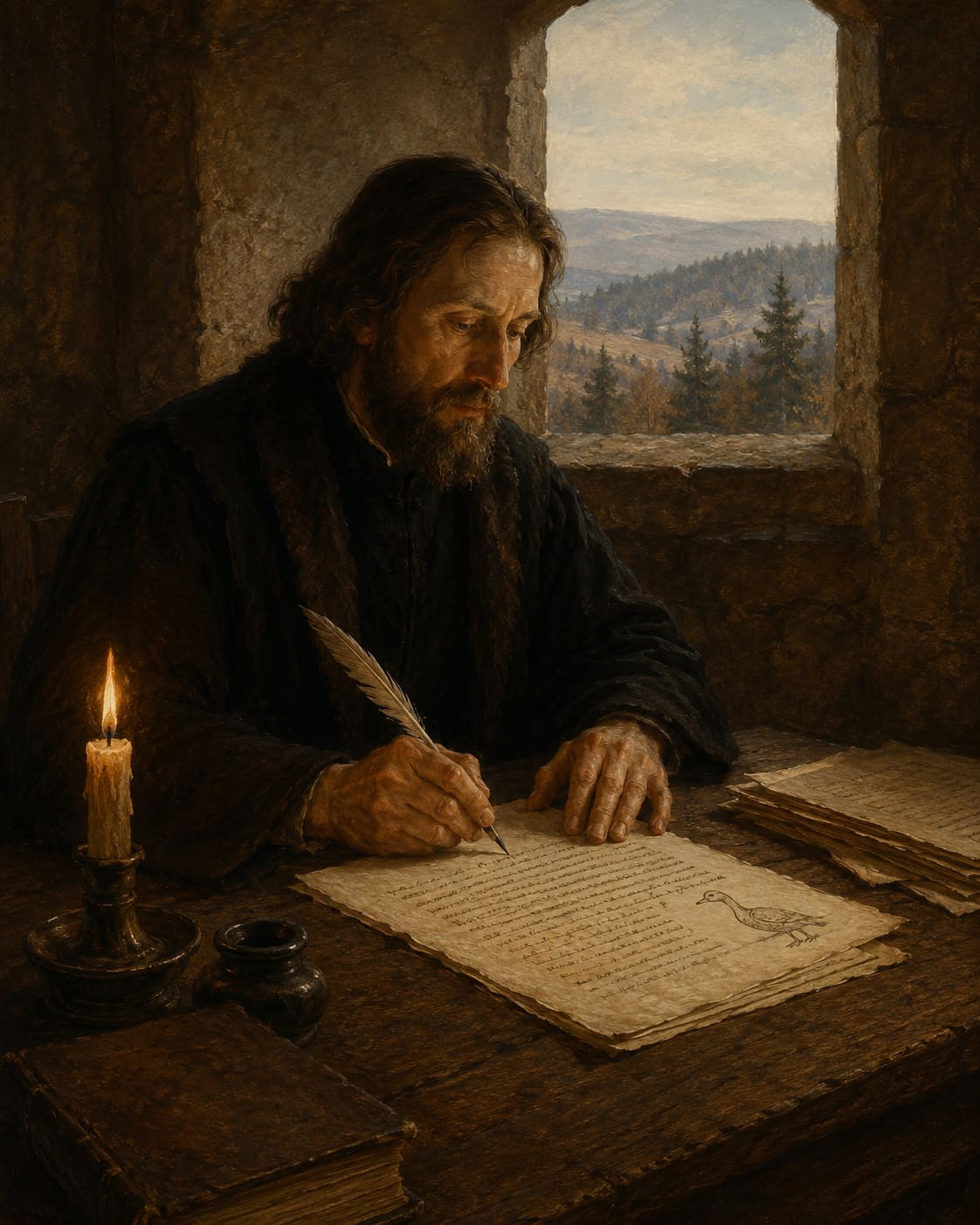
The trouble began, as it usually does, when the money moved. In 1411 the antipope John XXIII authorised the sale of indulgences in Bohemia to fund a war. Hus preached against it from the pulpit at Bethlehem. His excommunication, until then a paper threat, was enforced. Prague was placed under interdict — no services, no sacraments, no burials — for as long as he remained. In October of 1412 he left the city he loved and went into hiding in the castles of friends in southern Bohemia. From those rooms he wrote. Letters to his people in Prague. Treatises. A book called De Ecclesia, on the church.
In one of the letters, written in October 1412, he compared himself to a small bird trapped in the nets of his enemies. If the goose could not slip the snare, he wrote, then other birds, that fly higher and see farther, would break the nets in pieces one day. He did not name a swan. That gloss came later, from another century, in another country, from a monk who read Hus and wept.
In 1414 the summons came.
The Council of Constance had gathered in what is now southern Germany to end the Western Schism — three men were claiming to be pope, and Europe was exhausted. The Holy Roman Emperor, Sigismund, wanted the Bohemian problem settled too, and offered Hus a letter of safe conduct to come and defend himself. Hus's friends begged him not to go. He went. He arrived in Constance in November 1414. He was arrested on the twenty-eighth of that month.
They took him first to a Dominican monastery, then, when antipope John XXIII fled the city, they handed him over to the archbishop and locked him in the castle of Gottlieben on the Rhine. He spent seventy-three days there, chained day and night, poorly fed, sick. Sigismund's safe conduct was quietly set aside.
The first trial was on June 5, 1415. The last hearing was on June 8. He was not permitted a defender. He was not permitted, in the end, to speak to the articles as he wished. He was told, again and again, in different words, to recant. And he said the same thing back, in different words, each time. If they would show him from Scripture where he had erred, he would gladly recant. If they could not, he would not.

On the morning of July 6, 1415, they brought him to the cathedral at Constance. The mass was sung. Then the vestments of a priest were stripped from him piece by piece with the appropriate curses, and a paper crown was placed on his head painted with three devils and the word for heresiarch. The bishops handed him over to the secular power with the words, We commit your soul to the devil. He answered, looking up, that he commended his soul instead to Jesus Christ, who had redeemed it.
He was walked through the streets of the city to a meadow outside the walls. On the way he saw his own books burning in a pile. He smiled at the sight.
At the stake they tied his hands behind his back and bound his neck with a sooty chain and heaped straw and wood to his chin. One of the electors of the empire, Ludwig of the Palatinate, rode up at the last moment and asked him, once more, to recant and live. Hus knelt where he stood, spread his hands, and prayed aloud that God would forgive his enemies. Then he said the sentence that has come down to us in his own words.
“God is my witness that the things charged against me I never preached.”
The fire was lit. The wood was green and slow. He sang, they say, until the smoke stopped him.
The joke about the goose flew a long way. A hundred and two years later, in a town called Wittenberg, an Augustinian monk began to read the writings of a burned Bohemian priest and found, to his amazement, that he agreed with almost every line. Martin Luther would say, more than once, that he had been a Hussite without knowing it. In 1531 Luther put the goose-and-swan sentence into Hus's mouth in print — whether Hus had ever quite said it or not — and the sentence has been repeated ever since. The image was not invented. Hus had already written, from his hiding-place in 1412, that other birds would break the nets he could not.
Six centuries later the Czechs still keep the sixth of July. It is a public holiday. In Prague, in the Old Town, the Bethlehem Chapel stands where he preached, rebuilt from its foundations after the Second World War. His pulpit is a copy. His words are not.
They wanted him to say something else. He said only what he had said from the pulpit at Bethlehem, and from the castles in southern Bohemia, and from the cell at Gottlieben, and now from the pile of wood outside Constance. That the church should be judged by Scripture, not the other way around. That Christ is the head of it. That a man who has told the truth cannot untell it, even to save his skin.
The goose was roasted, and the joke did not die with him.
Scripture Behind This Story
37Pilate therefore said unto him, Art thou a king then? Jesus answered, Thou sayest that I am a king. To this end was I born, and for this cause came I into the world, that I should bear witness unto the truth. Every one that is of the truth heareth my voice.
John 18:37·KJV
Reflection
A man in a paper crown, tied to a stake, sang until the smoke stopped him. He had spent thirteen years in a pulpit saying one thing, and one night in a meadow refusing to unsay it. Not everyone is asked for that kind of steadiness. Most are only asked to say the same true thing twice in a week, in a room, to people who would rather they said something else.
Prayer
Lord, give us the plainness of speech to say what is true and the steadiness to say it again tomorrow. Where our words cost us little, help us not to trade them cheaply. Where they cost us much, hold us. Amen.
Quick Facts7
- Born
- c. 1369, Husinec, southern Bohemia
- Died
- 6 July 1415, Constance
- Also known as
- Jan Hus, John Huss
- Role
- Czech priest, preacher, university master, reformer
- Preached at
- Bethlehem Chapel, Prague, 1402–1413
- Condemned by
- Council of Constance, 1415
- Influenced
- Martin Luther and the Protestant Reformation
Timeline9
c. 1369
Born in Husinec, southern Bohemia
1393
Bachelor of Arts, University of Prague
1400
Ordained a priest
1402
Appointed preacher at Bethlehem Chapel, Prague
1411
Excommunication enforced after preaching against indulgences
1412
Left Prague for exile in southern Bohemia; wrote De Ecclesia and letters
1414
Arrived at Council of Constance; arrested 28 November
1415
Tried June 5–8; burned at the stake 6 July at Constance
c. 1517
Martin Luther, reading Hus, declares 'We are all Hussites'
Sources10
- Encyclopædia Britannica, 'Jan Hus'
- Catholic Encyclopedia (New Advent), 'Jan Hus'
- New World Encyclopedia, 'Jan Hus'
- Reformation 500, Concordia Seminary Library, 'Jan Hus'
- Christian History Institute, 'To Build a Fire'
- Concordia Historical Institute, 'Jan Hus: Reformer, Confessor, Martyr — Council of Constance'
- Matthew Spinka (ed.), The Letters of John Hus
- John Foxe, Acts and Monuments (Book of Martyrs), on Jan Hus
- Radio Prague International, 'Bethlehem Chapel — where Master Jan Hus preached'
- The goose-and-swan prophecy (traditional; Luther, Commentary on the Alleged Imperial Edict, 1531)contested
Part of the FaithMax library of Christian history — faithful lives across twenty centuries. Explore →